
Combo Metroidvania High Fit
Axiom Verge 2 review
The multi-dimensional exploration design carries Axiom Verge 2 even as its combat still leaves a lot to be desired. It completely captures the joy of breaking down a spatial puzzle.
Great
out of 5
Reviewed
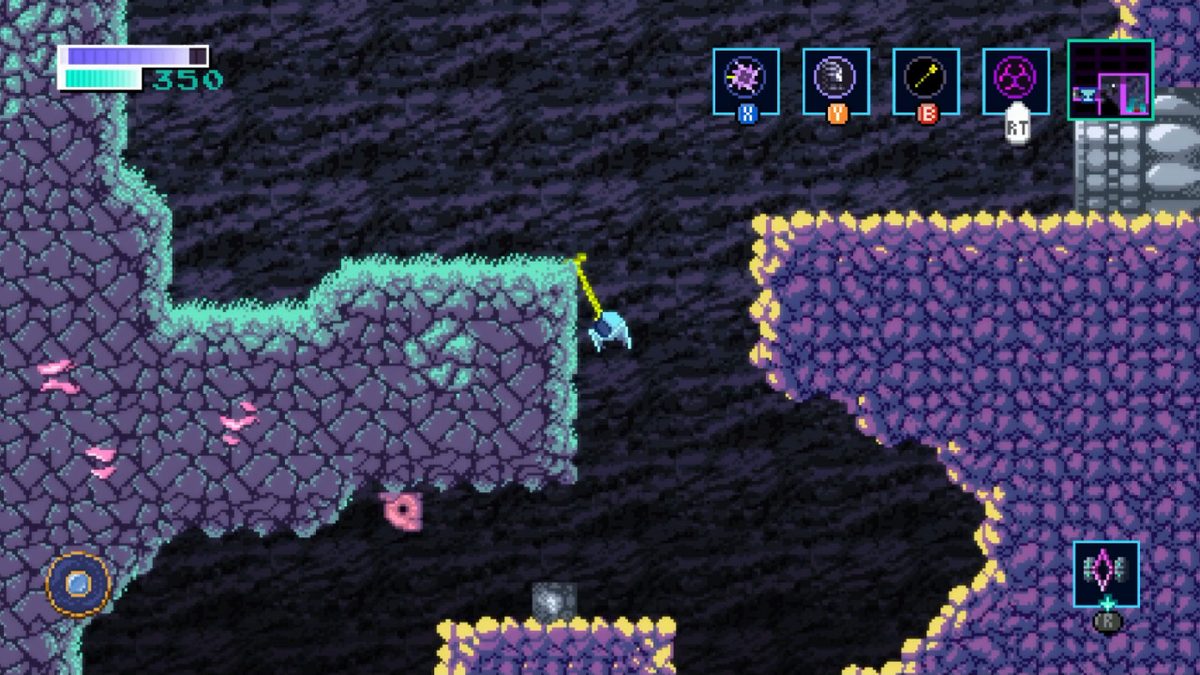
When reviewing sequels it’s really easy to fall into the trap of making the whole essay be about “this vs that” comparing the first game to the second. Putting aside the issue where readers shouldn’t have to do prerequisite reading or playing to understand a review, the comparison approach is more relevant when sequels are more iterative than innovative, since with iterative games the expectation is that the gameplay and other elements will evolve rather than mutate. While the original Axiom Verge was often criticized as being too iterative of the supposedly formulaic Metroidvania mold, its sequel completely drops entire aspects rather than build upon them. The result of this is that I can’t easily say “if you liked Axiom Verge 1, you’ll also like the second”, which is honestly something I’d rather not ever say about any sequel. If you really hated the combat in the first game, or thought that there were too many pointless weapons, or if you thought the code system for finding additional secrets was way too obtuse, then you’re in luck because Axiom Verge 2 does none of those things. Axiom Verge 2 drops these elements in favor of focusing more on its exploration – and that exploration is great if you don’t mind being completely lost sometimes.
Like any good exploration focused game you’re given control of your protagonist and are sort of thrown into the story in media res. The motives of your new female protagonist are inferred by conversations she has with others, making the whole reason you’re there in the first place part of the overall mystery. You’ll find scraps of paper scattered about that give you tidbits of lore and flesh out the universe, but more importantly the scope of the physical world you traverse unfolds gradually and organically. In that Familiar metroidvania fashion you’ll find new abilities that re-contextualize areas you’ve already been, and Axiom Verge 2 does a particularly good job layering spatial concepts on top of themselves and forcing you to think about the relationships between each place in order to progress. The core mechanic that drives this special spatial spelunking isn’t anything new – it’s kind of based on a mechanic that was introduced in a game that came out in 1991 – but it’s a mechanic that hasn’t been used enough, and Axiom Verge 2 uses it well. It adds an extra dimension to the exploration that couldn’t be accomplished in any better way. This in combination with there being so many so many staple collectables for you to find – more than you’ll probably ever need – which creates an unparalleled puzzle box that Metroidvania fans will find delightful. Some of the collectable skill points are so cleverly hidden that you’re bound to get a sense of accomplishment for finding many of them. Unlike the more riddle focused codes in the first game, most of the secrets in Axiom Verge 2 are completely grounded in spatial reasoning, thus the logic necessary to succeed has more opportunity to build on itself rather than force you to learn a new mechanic late into the experience.

One of the more popular tools in Axiom Verge 1 was the remote drone, and the drone is one thing brought back in Axiom Verge 2 that has evolved significantly. Previously the drone was simply another stand-in for Samus’ ball form – a means of getting through tight spaces as yet another ability gate – with the drone being one of the more creative solutions to the small gap problem. In Axiom Verge 2 however you’ll more than likely spend more time controlling the drone than you will be walking around as a human. So many awesome movement tools are connected to the drone and combat-wise its basic attack is at least comparable to the weapons available to the human. The greater emphasis on an what is effectively a second form this time around enhances the already intricate world design. To add to it, there are direct narrative and ludonarrative metaphors associated with this aspect of the gameplay that are fun to think about. It’s a delicate mix of individually simple elements to create something complex and beautiful, and enjoyable to break down piece by piece.
To help navigate its complex world, Axiom Verge 2 is filled with tools that help it respect the player’s time. The mapping system is far more detailed than it usually is in any Metroidvania game. The map is still organized in a grid with squares representing rooms without screen transitions, but the squares are painted with details of the room’s terrain that make it much easier to remember what was in them. You can also place dots anywhere on the map at any time, which make it a lot easier to remember where you saw something suspicious, or in my case it helped me mark where there was a gate creating a dead end in places that otherwise might look like I could progress from. A little bit into the game you get the ability to fast travel to any save point in the zone you’re in, and you can do this at anytime from anywhere. The save point locations still mean that even with fast travel you’ll probably have to walk to some of the areas you suspect might hold a secret or a progression tool, but it does save a lot on trekking from one side of the map to the other. It makes focusing on places where you haven’t tried exploring that much easier. You also get a compass that is possibly the most obtuse tool in the game, but if you figure out how it works, it does give hints on where secrets might be hidden, and it will tell you when you’ve cleared a particular room after an upgrade. Feasibly you can find every secret in Axiom Verge 2 using its tools without resorting to a guide, and thanks to fast travel you can do it with a level of time investment that might even be faster than using a guide. In terms of Metroidvania exploration, Axiom Verge 2 is exemplary, and maybe even a standard to look to in terms of quality of life offerings.
Unfortunately the exploration is where my praise of Axiom Verge 2 ends, and while the rest of this game’s features are at worst passable, they do bring down what could have been the next 5 out of 5 masterpiece. Sticking to the subject of exploration, its the biggest flaw is that most of the rewards you’ll find will only service the game’s weaker aspects. Lore tidbits are interesting but the actual story is almost a bit too straight forward this time around, and as always these types of flavor texts don’t actually affect how you play the game. Axiom Verge 2’s staple upgrade are jars that provide you with skill points to spend how you choose – and maybe your right to choose is part of what makes them a bit weak as a reward. On the skill tree there’s exactly one set of upgrade options that can affect how well you can get to places, and once you’ve maxed those skills out everything else is about increasing your ability to perform in combat. You can raise your health, make yourself do more damage, or make it so you attack faster… so you can do more damage. At a certain point – way too early on – getting skill points just doesn’t matter anymore, and by the end of the game I actually found myself disappointed when the thing I discovered at the end of a secret passage was yet another skill point jar. Most of the things you find are going to be skill jars. There are a few optional weapons or artifacts that have more interesting effects, but skill jars are going to be your main thing. There are three different weapons you can use to damage enemies, but the drone’s buzzsaw is going to be the only one you can use everywhere – so why not use it everywhere? Even Metroid’s missile ammo upgrades didn’t suffer from this irrelevancy problem as quickly, in spite of being somewhat redundant in terms of providing power to the player. More missiles in Metroid means more opportunities to miss, and that means bosses are easier thanks to the onslaught of your arsenal. In Axiom Verge 2, if you’re spending your skill points wisely early on, then further skill points only serve to help you strengthen weapons you’re not using, which is useless. Thankfully finding secrets can be rewarding unto itself in spite of there being no tangible in-game benefit, but part of the appeal of a Metroidvania over a collectathon is how usable the hidden treasure can be.

Combat was Axiom Verge 1’s biggest bugaboo, and Axiom Verge 2 is only marginally better. In the first game enemies that were actually aggressive toward you had annoyingly unfair pathing, and thus the strategy became using level geometry to exploit their simplistic AI. Axiom Verge 2 tries to rectify this by introducing awkward stealth mechanics. Early robot enemies have giant laser fields that extend from their cameras indicating their field of vision. If you avoid this field then the enemies will ignore you, but usually the robot is stuck right in your path anyway, so basically sneaking up on them just means you get a free hit in. If you ignore the stealth mechanics the enemy design is still a bit stronger compared to the first game. Most enemies will telegraph their attacks much better this time around, and your melee weapon has a decent knockback so with proper timing you can push them away just as their attack lands to avoid the hit. These are good design concepts that if tooled properly could have made for some decent combat challenges, but Axiom Verge 2 doesn’t really take that direction. In fact later on enemies just kind of drop the whole stealth mechanics approach and fall into the same patterns they did in the first game. Thus upgrading your health either through skill points or collectable health upgrades and tanking the hits while spamming your own attacks summarizes the combat experience for most of the game. The tank and spank strategy is especially effective after you’ve maxed the damage on whatever weapon you’re using.
You can also ignore most enemies entirely – there really isn’t a reason to kill anything except the so called “bosses” unless you’re just trying to grind for HP. For whatever reason the media surrounding Axiom Verge 2 is abuzz about how bosses are skippable in this game, but to make that a marketing point or a major point to focus on kind of over inflates what a boss is or what role they play in this game. There are very large enemies you can fight that you’ll just sort of find while traveling around, and if you kill them they’ll drop a skill point jar and never respawn. Some of these big enemies are found in dead ends in lieu of just finding a skill point, which is slightly more interesting than just finding the jar I guess. Most of these mini-bosses can be easily defeated by mashing your attack button just like everything else though, assuming you’re managing your health resources. There are exceptions to this, with two or three stand outs in particular, but in general besides the final encounter you don’t even need to max even one of your combat skills to do just fine. Plus you can skip them anyway, and as I said you don’t really need all the skill points the game gives you, so why not skip them.
I don’t really mind that the combat in Axiom Verge 2 is as throw-away as it is. I actually like this setup more than the first game. The only problem I have with it is that as I mentioned it kind of degrades the value of the exploration simply by association. Getting more powerful is meaningless if there’s nothing meaningful to apply that power against. It does create an interesting conundrum that’s worth discussing though – what other direction could Axiom Verge 2 have taken to reward its exploration besides combat? With the stealth elements seen at the beginning of the game its clear that Tom Happ was playing around with ideas, but I don’t think he was able to get to an interesting conclusion at least with this sequel. If there’s going to be an Axiom Verge 3, to really make the best it can be, its either going to have to come up with a combat system that compliments everything else, or its going to have to find something new and innovative to do instead. I’m much more interested in the latter.

Axiom Verge isn’t just about the combat and exploration, it also offers up a great sci-fi world with philosophical ideas to chew on. This second game gives a lot more color to that world, but as for philosophy it’s a bit weaker. There are still plenty of existential concepts to dwell on, but the actual plot you’ll be playing through could be something out of any video game. What I like the most about Axiom Verge 2 is how it creates so many threads that could be built upon later, and in that sense it almost works as a better first game than the original. The straight forwardness of the plot is more accessible and thus might even make this game a better starting point for new players. It’s also written in a way where the first game isn’t mandatory – although they do both use concepts that compliment each other. Attempting to Trace lines between the two games could be good fun for those that enjoy doing that sort of thing, and watching Tom Happ expand this world even further with more sequels is something I look forward to.
Unparalleled exploration design with some all too easy combat and a more straight forward story summarizes Axiom Verge 2. Whether this game should be placed at the top of your priority list depends on what kind of player you are. If you find yourself more enamored with figuring out how to get a secret than you are with the reward the secret provides, then Axiom Verge 2 was made for you. If “great combat” is part of what makes or breaks a Metroidvania for you then you’ll probably be disappointed. My tastes are a bit more eclectic, and I really appreciate the occasional game that doesn’t focus so much on the twitchy challenge aspects. The only issue I have with the way Axiom Verge 2 does things is that the exploration rewards are in support of system that could use a little more fleshing out. That said, the exploration really is just that excellent, and I think Axiom Verge 2 is great on the merits of that alone.
Difficulty
How hard is Axiom Verge 2?
Not really. Axiom Verge 2 scores 31/100 on our difficulty scale (#183 of 207). Gentle challenge — a good pick for newcomers to the genre.
- Our review: rated low difficulty.
- Steam players: 29% of 238 English reviews describe it as hard, 17% as easy — harder-rated than 40% of games here.
Final verdict
Axiom Verge 2
The multi-dimensional exploration design carries Axiom Verge 2 even as its combat still leaves a lot to be desired. It completely captures the joy of breaking down a spatial puzzle.
Metroidvania breakdown
Combat
3/5Combat is improved from the first one in the sense that it's not just about pathing exploitation, but it's also basically optional now, making it less of a focus
Platforming
3/5Platforming is about getting from point A to point B, not about challenging the player
Exploration
4.5/5Masterful. The only thing holding the exploration back is the rewards start to become less meaningful a little too early as you approach the end of the game, thanks to the game having fewer other challenges.
Puzzle
2/5Exploring the map and figuring out where you can go is a puzzle, but I generally include that aspect of challenge with the exploration score. There aren't really any physics or logic puzzles to solve.
Story
3.5/5Not as strong as the first game, but there are some compelling enough sci-fi ideas to at least intrigue the mind even if it might not cross over into something truly meaningful.
Graphics
4/5The varied environments and backgrounds look fantastic
Music
5/5Like the first game the tracks are extraordinary compositions having merit beyond ambience or simple background music
Replayability
3/5There may be ways to sequence break this game yet to be discovered, but the skill tree is too simplistic to offer build variety and there aren't currently difficulty mode options. There is a speedrun mode however to ease that challenge.
Axiom Verge 2 was played on Windows PC using the Epic Game Store version
Featured in
Further reading
If you liked Axiom Verge 2
All reviews →
Axiom Verge
Captures the feel of Metroid while doing more than enough to establish its own identity. Metroidvania Exploration at its best, with a thought provoking (but enigmatic) story to go with it.

Ato
Frenetic gameplay and novel and deep mechanics are wrapped up by an emotional silent narrative, making Ato one of more memorable experiences within the Metroidvania genre.

The Mummy Demastered
While it has a bit of a slow start, it proves itself to be a solid combination of Castlevania and Run-and-Gun platformers. Face off with some excellent bosses using the weapons you find.