Linear Platformer Hybrid Medium Fit
Castle in the Darkness review
Filled to the brim with creativity even with all of its many references to 80s game culture. The punishing difficulty will cut you down to the bone, but if that's your jam, it's amazing.
Good
out of 5
Reviewed
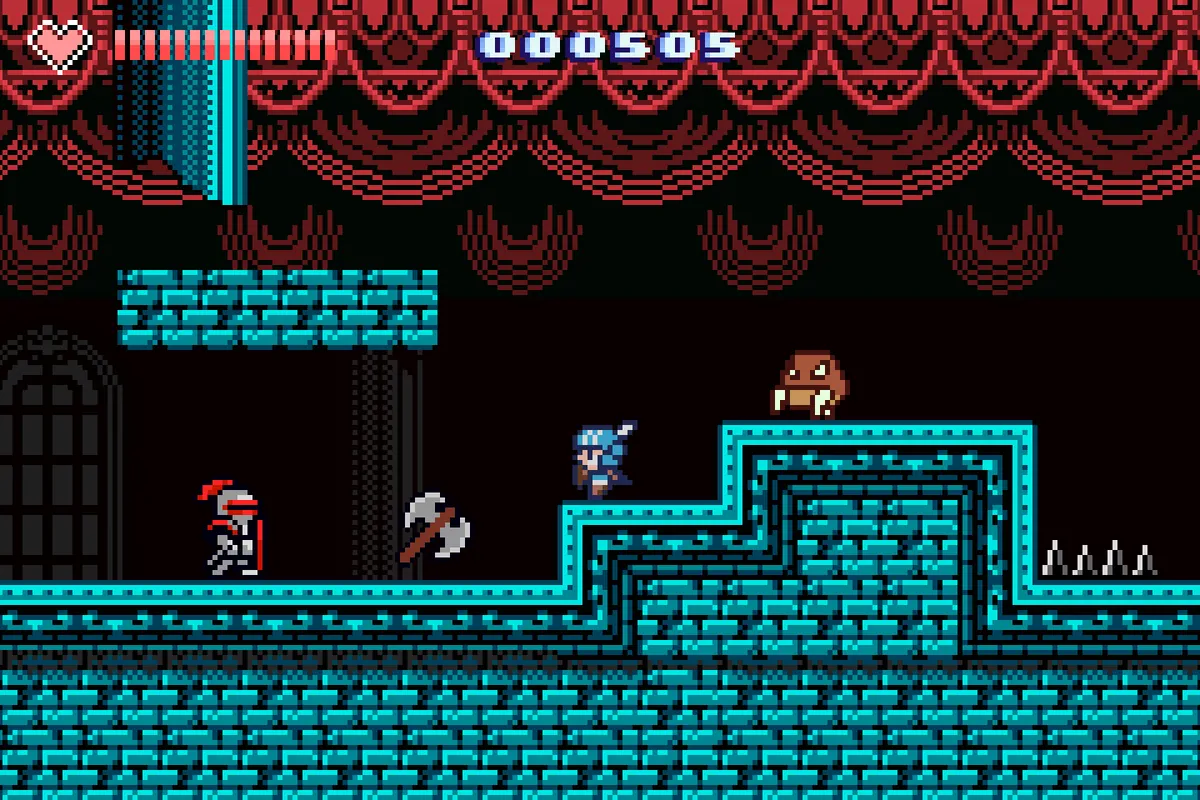
Castle in the Darkness is a game you’ll either love or hate, or if you’re like me, both. It’s a creative love letter to pop culture recognizable to anyone born in the United States of America in the 1980s, with an original spin keeping it fresh and curious for nostalgic fans of that era. Part of that love letter was written in blood gathered from the fingers of children after they broke their controllers, however, as all of the punishing difficulty of those ancient games is fully celebrated here. Whether or not this is a deal breaker or an attractive feature just depends on how you like your difficulty served up.
The plot is one anyone familiar with 80s gaming has already heard. An evil Sorcerer is being evil, and the princess is missing. You’re the last surviving of the King’s Guard, and your job is to poke things with your wholly inadequate sword until you find better tools. There are so many direct references to older video games that I dare say that it may be more challenging to list everything that isn’t a reference. You’ll run into good ol’ Firebrand and Arthur from Ghosts ‘n’ Goblins, Blue Hedgehogs, an Elf Boy who tells you it’s dangerous to go alone, Fairies that shout at you to listen, and more. In the midst of all of this though, Castle in the Darkness manages to remain fairly unique in all of its offerings. Bosses may include references to Double Dragon and Symphony of the Night, but the challenges themselves present a fresh take even for those who have played all of those games.
The game even plays on your expectations with some hilarious results – if you don’t mind being kicked in the ribs a few times. For instance, when you reach the titular Castle you’ll find the same kind of candelabras you might find in a Castlevania game, which if you’ve played those games you’re already hardwired to break them as soon as you see them. In Castle in the Darkness however instead of ignoring all logic and offering hearts as a reward for destroying them, the candle instead explodes into a dangerous flame that will likely burn your face if you’re too close.
Bosses are easily the best part of Castle in the Darkness for me, and are the part of the game that justifies the Metroidvania aspect. All of them are excruciatingly difficult if you’re still stuck with the original starting weapon – maybe even impossible in some cases. Every boss defeated gives you a little extra health, and there are other weapons obscured in a very “Zelda 1”-like fashion, meaning that if you’re ever having trouble, finding new tools and switching up your strategy can usually pull you through. A boss that seems unfair will often bow down instantly to the right weapon or spell. It’s fun and rewarding to explore more and take these jerks down.
However, no amount of exploration and secret hunting will help you against your true enemy, Instant Death, and by the end of the game there’s so much of it. I’ve had to take a few days after completing this game to reconcile my personal biases against what is actually counterproductive game design, and I think it really boils down to what you consider to be fair and unfair. If “Fair” to you is a game that is consistent – no RNG – that can be completed with your skill even if it takes a few tries to get foreknowledge of what’s coming, then Castle in the Darkness is a fair game and you may like its antics. If fairness also includes reasonable telegraphing so that an experienced player could reasonably avoid all obstacles without dying, then this game is likely going to rub you the wrong way. I don’t personally have a problem with trial and error mechanics – I think memorization is a skill that’s worth developing and can even be fun to develop. In fact, there are a lot of games that have been successfully based around this concept, like Bit Trip Runner. I personally think Castle in the Darkness crosses the line a little too far – and this is coming from someone who would adamantly defend Quick Man’s stage in Mega Man 2 as a good level. There are too many death traps that come from off screen at speed that it’s impossible for you to react fast enough. It’s incredibly frustrating to have defeated a hard boss only to slip slightly and die instantly on a spike as you return to the nearest save point. “Gotcha” moments can be funny, but they get old pretty quick when you’re really just here for the game’s other offerings. Unfortunately as the game progresses it starts to look closer to a game like I Wanna Be the Guy than it does something like Metroid or Castlevania – which again is a great thing if that’s your jam.
To be fair though, the worst of the game’s frustrations are technically optional, and it’s not all bad even when instant death is involved. I really enjoyed the prison section of the game where navigating instant death corridors are practically the main theme. I also think that all of the game’s existing challenges are serviceable – it just perhaps needs a few more checkpoints to even out the wonky difficulty curve.
There’s a lot of talent that went into Castle in the Darkness, and if you are able to enjoy the punishing difficulty, you’ll find a rich world filled with secrets and challenges. You may even consider it one of your top games. I personally respect the unbridled design; the unburdened expression of the game’s creator. Castle in the Darkness made me smile more than it made me bleed, but you’ll have to excuse me while I get some more band-aids.
Screenshots
Images: Steam store page ↗


Difficulty
How hard is Castle in the Darkness?
Yes. Castle in the Darkness scores 100/100 on our difficulty scale, the #1 hardest of 207 Metroidvanias reviewed here. Built to punish — expect to die a lot and learn patterns the hard way.
- Our review: rated brutal difficulty.
- Steam players: 58% of 225 English reviews describe it as hard, 16% as easy — harder-rated than 99% of games here.
Final verdict
Castle in the Darkness
Filled to the brim with creativity even with all of its many references to 80s game culture. The punishing difficulty will cut you down to the bone, but if that's your jam, it's amazing.
Metroidvania breakdown
Combat
4/5Combat is basic, but there are a varety of weapons and spells that you can use to change up your strategy, adding depth to preparation
Platforming
3.5/5Technically excellent at points, but the constant barrage of instant death mechanics will likely chip away at your sanitiy
Exploration
3.5/5Secrets are tucked away behind hidden walls and riddles, but it's done with little guidance. Reminiscent of the first Zelda game
Puzzle
3/5Not a huge focus, but there are some good riddles to help you figure out some of the more difficult secrets
Story
3/5The narrative does its job. Nothing special but doesn't detract from the game either
Graphics
4/5Ranges from a generic 8-bit look to some gorgeous pixel art portraits. Overall high quality
Music
4.5/5Intentionally uses musical phrases from nostalgic games, and its as good as its inspirations because of that
Replayability
3/5If you aren't completely beaten down from your first playthrough there's a new game + mode with even more secrets to unlock
Castle in the Darkness was played on Steam
Featured in
Further reading
If you liked Castle in the Darkness
All reviews →
Castlevania II: Belmont’s Revenge
Some Brutally Hard moments aside, the creativity of this Gameboy title sets it apart from its Classic-Vania console counterparts.
Castlevania: The Lecarde Chronicles
A strong Classicvania experience with some of the series' later mechanics mixed in. A worthwhile playthrough assuming you don't have any technical issues.

Frauki’s Adventure!
If you're able to get past some of Frauki's Adventure's rougher edges, you're in for a short and sweet, and brutally challenging mini adventure with some fun exploration as a bonus.