
Zelda-Like Medium Fit
Elliot Quest review
Bosses are hit or miss, the map design is a little sloppy, and the payoffs are disappointing, but there is still a lot here for exploration enthusiasts to fall in love with.
Decent
out of 5
Reviewed

Elliot Quest made me realize that games that draw inspiration from Zelda 2 are apparently my jam, because I haven’t found a Zelda 2-like game yet that didn’t at least compel me. It’s also the best explanation for why in spite of all the problems Elliot Quest has, I can’t completely disregard everything I still like about it. Elliot Quest is also a game that proves the value of my rule that I must achieve at least one of the game’s endings before I can review it, but in this case that rule very much works against Elliot Quest. It has a solid foundation that even with its rougher edges it could have gotten away with quite a lot, at least for me. Possibly because it spread itself too thin, the longer I played Elliot Quest the more it felt like it was stretching too hard to provide a challenge, and it gets to the point where it tramples on its own strengths. But I’m getting ahead of myself, Elliot Quest still has a great hook for its narrative and a ton of secrets to find that I think that if you are able to overlook its weaknesses it may still become a classic for you.
The way Elliot Quest tells its story is through flashbacks via text over the action as you are going about your business completing dungeons. Surprisingly this does a lot for keeping its simpler dungeons interesting as it provides much needed context to what you are doing. Without this text a lot of the game’s activities would feel kind of pointless. Not that the game’s challenges are bad per se – well some of them are – but it’s more that I was willing to push through some of the more mundane tasks because Elliot Quest promises there’s going to be something great waiting on the other side. As our protagonist Elliot’s motives become more clear a few of the other game’s mechanics start to have deeper meaning. On your character’s stat screen there’s an alignment indicating Elliot’s state of mind, and actions like stealing from the townsfolk or sacrificially going out of your way to save them shifts you toward good or evil. Being “good” is especially challenging, requiring you to unlock more of the game rather than just charging straight into the final dungeon. The most rewarding thing about being good is enjoying more of the game’s content, as unlocking content is the strongest feature Elliot Quest has to offer.
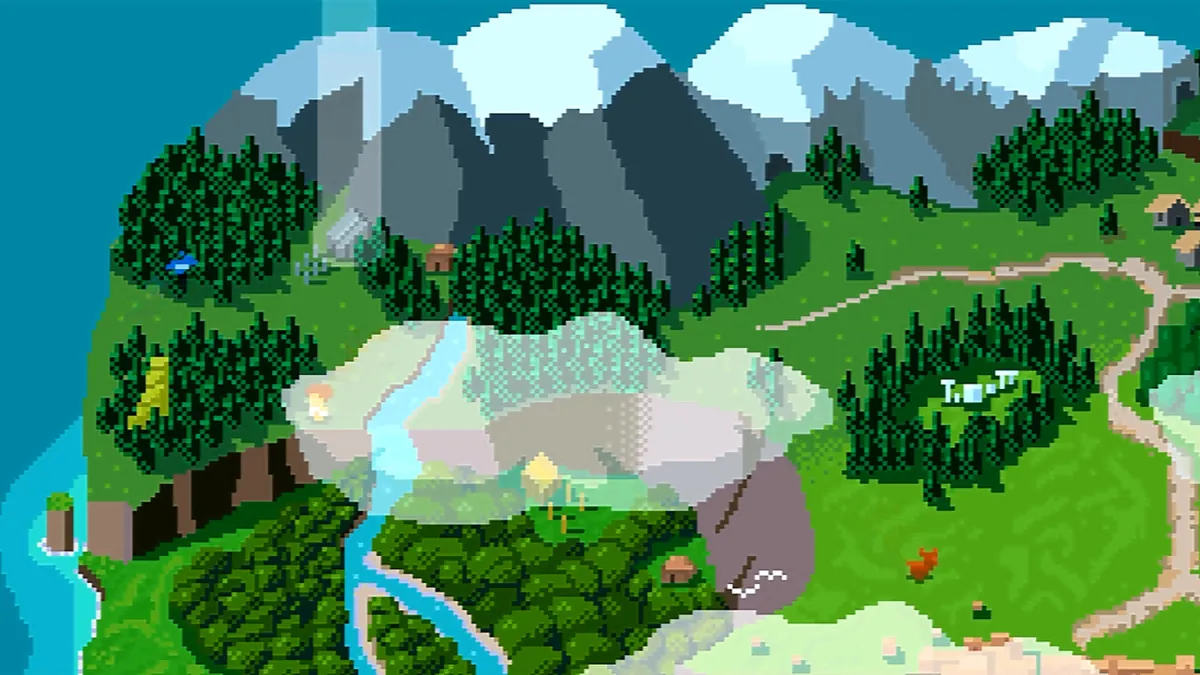
The game takes place on an island with an overworld map, and as you wander that map you’ll encounter exclamation marks that represent the various areas you can explore via 2D Platforming. Combing every pixel of the overworld is not only rewarding, since not every secret is clearly conveyed by the artwork, it’s also necessary for progress. This “feature” is going to be hit or miss for a lot of people. There were several points in the game where I felt completely lost, and since Elliot Quest has very spotty fast travel options, wandering aimlessly took up a lot of my 16 hour playtime. On the other hand, the lack of guidance was also weirdly compelling. Imagine trying to beat Zelda 2 for the first time without a guide. I’d suggest it would likely be even worse than what Elliot Quest does, but then Elliot Quest is a much bigger game. There’s a notable lack of direct tutorials, and while the game does teach you its mechanics wordlessly, it’s also pretty easy to forget what you’re capable of doing as you get deeper into the details of the map. For instance there’s an entire peninsula hidden away in one of the game’s caves, and even though I knew I had more to do in that area I could not for the life of me remember which of the blasted caves led to it. Backtracking in and out of these segmented areas could use a few more shortcuts too, since you’ll be repeating a lot of platforming challenges as you explore. The way 2D Platforming Sections are imposed on the player if they want to access other pieces of the game’s map can lead to a lot of this repetition. The disconnect between the overworld and 2D sections makes it extra hard to parse the relationships between areas. The idea of a world map can be done well – in my opinion it was done well 6 years later – so the issue here with Elliot Quest is ultimately just poor map design. I’m not saying shortcuts don’t exist – thankfully there are quite a few – but the actual issue here is that not enough is done to give you a sense of place. Without this sense of place it was much harder for me to remember where I should go when I got a new shiny movement upgrade.
I still give Elliot Quest an A for exploration challenge though, even if it is a bit sloppy. Maybe because it’s a little sloppy it has value as a unique challenge for someone like me who has played so many of these Metroidvania games that something a little more obtuse can be refreshing. I genuinely enjoyed picking this game’s world apart, and to be completely fair, most of the time when I did find where I was supposed to go it was easy to pin the actual problem squarely on myself and not because the level design has any legitimate issues. Most importantly Elliot Quest has some intriguing secrets only serve to tease an exploration enthusiast like myself. One of the rewards for your exploration are these blue crystals that you need to open slotted doors across the island, and some of Elliot Quest’s most interesting content lies behind these doors. This made finding the crystals quite gratifying and I was hungry to see that content more than I was ever annoyed or bored by the exploration specifically. Some of Elliot Quest’s most frustrating content is also beyond those crystal doors, but none of it is worse than the final boss – but I’m getting a head of myself again.
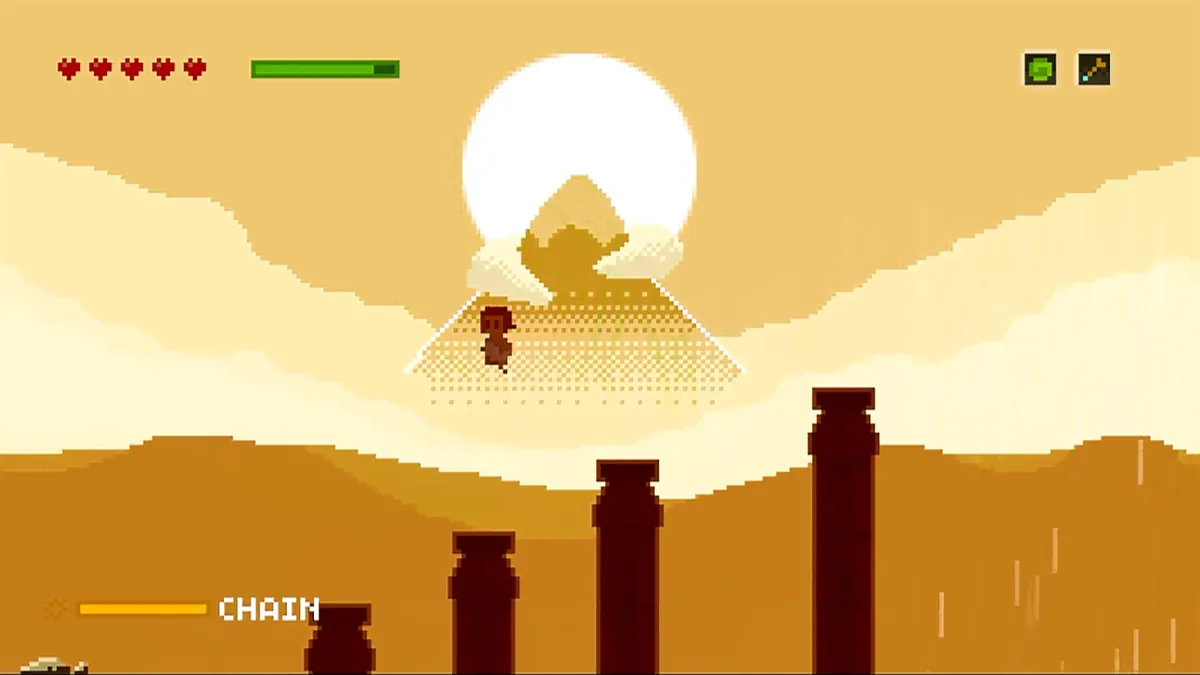
Within the dungeons there’s a mix of combat and puzzle challenges, with the latter making up the more interesting of the two. The more tools you gain the more complex the dungeon puzzles become, with each dungeon having some kind of special gimmick that gives it a unique identity. A lot of the time these “puzzles” are obvious activities that you just sort of perform while fending off a few random baddies, but some of them really make you consider the entire dungeon map in order to solve them. For the most part, I really have no complaints about the dungeons when they’re focused more on that Zelda-like puzzle goodness. There are some great spells and puzzle tools that you’ll find and assuming you don’t forget about some tool along the way (like I did a few times) the challenges build on previous challenges quite nicely. However, there are some points where you have to deal with the game’s physics to solve puzzles, and this can sometimes be a problem, like if you happened to have increased your movement speed by boosting your agility. The game doesn’t always seem to take that differing movement speed into account with its level design. Most of this time this works to your benefit making the activities much easier. There’s one puzzle in particular though that I felt like I had to exploit oddities in the engine to get it to work, and this is only one example of where it feels like Elliot Quest could have used a bit more testing or at least a patch within the last 7 years since its release.
That leveling system will likely be another deal breaker for players that dislike harsh punishments for failure. Like Zelda 2, killing monsters will level you up, and you can spend level up points on one of five stats. Raising your strength makes you arrows shoot further. Boosting your wisdom makes your magic better and cost less – something especially important for the late game. Agility makes you faster, primarily when it comes to rapid firing your bow but you can also get a movement speed upgrade like I mentioned. Vitality makes healing items work better and you can even regen your health at high levels. And finally accuracy gives you a chance to do double damage and sometimes kill non-boss enemies outright. It’s all pretty standard stuff, but it’s worth noting that none of these stat upgrades provide just simple numeric increases – each level can fundamentally change how you play the game. The catch to this leveling system is that when you die you lose some of your exp, and the loss a lot more than you probably want it to be. You can never drop below a level that you’ve already achieved, but it can be especially challenging to get to the next level without straight up grinding if you find yourself dying a lot. Also this game really wants to kill you. You do keep any ability upgrades you find, crystals, hearts, or magic power ups, and your map and dungeon puzzles remain completed, so losing exp is still less punishing than simply starting over from the last time you saved. That doesn’t stop it from feeling overly punishing though, especially in the sections hard enough that they start to feel unfair. The worst aspect of the exp loss is that Elliot Quest also includes instant death if you happen to fall into a bottomless pit. This can make the platforming more punishing than any of the game’s combat challenges, and it turns what is already a fairly basic if not wonky set of platforming challenges into a sometimes aggravating ordeal. If you’re facing off with a hard boss you might as well just kiss your exp progress goodbye – or just go grind it out until you’re comfortable with leaving it at the floor of whatever level you gained last.
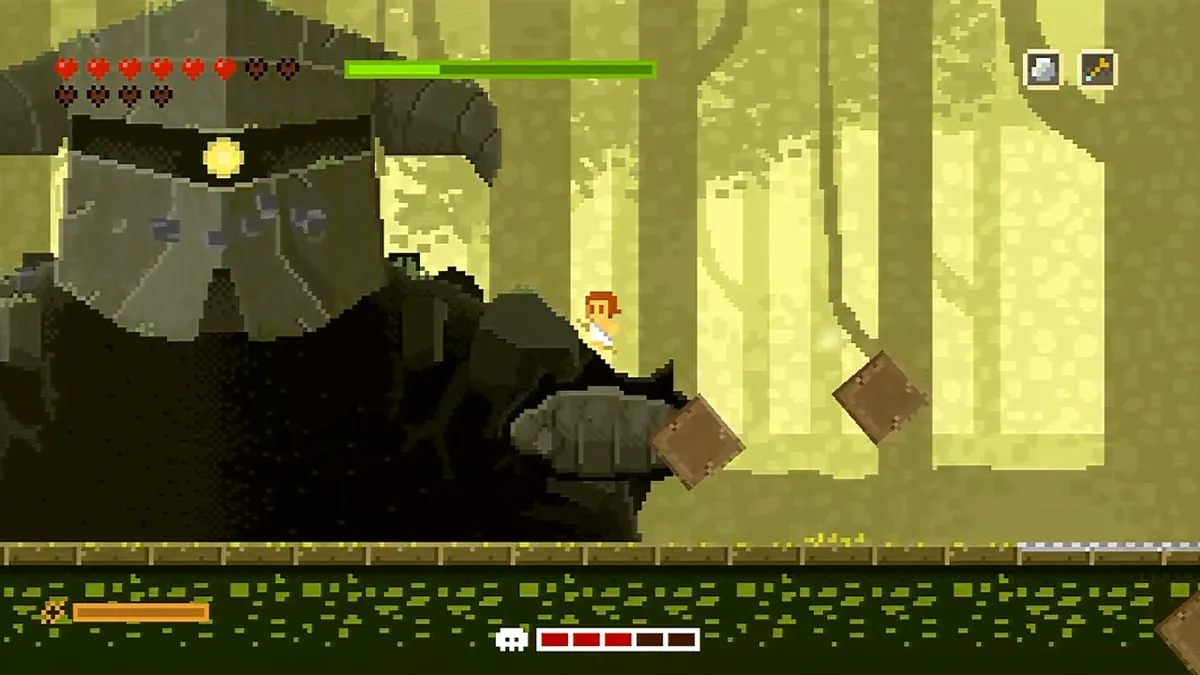
Combat itself has you volleying arrows at your foes and outside of bosses it’s usually more a matter of finding a place to stand where the enemy can’t reach you than it is the kind of actiony jump and shoot you’d find in… well… a better action game. If you’re not keeping your arrows fully upgraded, and you haven’t invested in the faster shot speed that raising your agility gives you, killing things is going to be especially slow and tedious. The bosses on the other hand are another story. They can be great encounters with interesting patterns and/or puzzle aspects that make them truly memorable. Just like most of the content in Elliot Quest though the bosses can be hit or miss, and when the bosses miss the mark it usually lands somewhere where it hurts. The most egregious boss of all is unfortunately the final boss. Final bosses are at their best when they utilize all of the skills you have learned leading up to them, and Elliot Quest not only doesn’t make you use previously learned skills but it also makes a large portion of what you’ve collected or done to level yourself up completely obsolete in the process. It’s like an ironic anti-final boss just daring you to suggest something worse. It’s a massive let down to finally face off with the villain the game has been building up for over ten hours only to discover it’s an awkward mess with a poorly thought-out gimmick.
It also pains me to say that even though Elliot Quest does a great job using its narrative as a powerful hook to pull you forward, the payoff is a bit weak. Like many stories with strong premises, you can still get a lot out of it if you put something into it, but Elliot Quest necessarily requires some creativity on your part to fill in the gaps. There needs to be more memorable NPC characters to make being good aligned more satisfying. The neutral path is a bit cathartic and ironically ends up being the most satisfying for that reason, even if it’s not necessarily the best outcome overall. Embarking on the evil path is so overtly evil that there’s no significant moral quandary, and it’s a shame because there are elements to the story that could have made it a heck of a lot smarter if they were expounded upon.

Needless to say my ultimate opinion of Elliot Quest is that it’s a mixed bag. If you’re okay with some rough edges and a payoff that frustratingly doesn’t live up to its potential, you still might find a lot of satisfaction exploring Elliot Quest’s little world. There are some excellent bosses and dungeons that do a great job playing to Elliot Quest’s strengths, and I choose to linger on those memories when considering whether I regret spending time with this one. If you hate getting lost in Metroidvania games, then Elliot Quest is the emperor of what you hate, but I for one thought it was this game’s most compelling feature. Especially now there are a few other Zelda 2-esque options out there that I would recommend first, but if you’ve already played those, and Zelda 2 style games are also your Jam, then Elliot Quest should be on your list.
Difficulty
How hard is Elliot Quest?
Yes. Elliot Quest scores 75/100 on our difficulty scale, the #38 hardest of 207 Metroidvanias reviewed here. A real challenge; most players will hit walls that take practice.
- Our review: rated high difficulty.
- Steam players: 38% of 118 English reviews describe it as hard, 15% as easy — harder-rated than 74% of games here.
Final verdict
Elliot Quest
Bosses are hit or miss, the map design is a little sloppy, and the payoffs are disappointing, but there is still a lot here for exploration enthusiasts to fall in love with.
Metroidvania breakdown
Combat
3/5There are great moments, with some fantastic bosses, but it's hit or miss, with the final boss being the biggest disappointment
Platforming
3/5There are some decently challenging and competent platforming sections brought down somewhat by how punishing the instant death can be
Exploration
4/5It can be frustrating sometimes to figure out where you can go next, but once you've gotten past that the world is fun to peel apart and discover what's hidden in it
Puzzle
3.5/5Elliot Quest's puzzles are a mix of mundane activities and some genuinely good stuff. Some of the more physics based ones can be a bit broken, but overall they do help keep dungeons engaging
Story
3.5/5Elliot Quest has a better hook than most games, but the payoff isn't particularly strong
Graphics
3.5/5The pixel art holds up decently well, but it's not as good as even the retro games that inspired it
Music
3/5The music genuinely sounds like it comes from the SNES, but the tunes are fairly generic, getting most of their value from the nostalgia they inspire
Replayability
3.5/5There are a lot of ways you can approach Elliot Quest thanks to a skill tree and an alignment system that will affect the ending you get, although thanks to the difficulty and huge amount of things to do, it may be cumbersome to play this game the three times necessary to see it all.
Elliot Quest was played on a Windows PC using the Steam Version
Further reading
If you liked Elliot Quest
All reviews →
Mask of Mists
- A relaxing semi Zelda-like experience that will provide a pleasant five hours of basic gameplay to enjoy. It's fun. It's not a groundbreaking title but I don't think it's trying to be.
Shantae and the Pirate’s Curse
Heads and shoulders above its predecessor, Shantae and the Pirate's Curse is a exciting romp in a colorful world with quirky characters and slightly dark humor.

Alwa’s Awakening
A slower-paced puzzle platformer with unique spell casting challenges. Excellent level design makes finding collectables a treat. Stumbles slightly at the end but still well-recommended. Share