
Zelda-Like Medium Fit
Phoenotopia Awakening review
While the difficulty and some features may grate against individual preferences, its immersiveness and gameplay variety combine to make Phoenotopia Awakening an absolute masterpiece.
Masterpiece
out of 5
Reviewed
Phoenotopia Awakening is a remake of the 2014 browser flash game simply called Phoenotopia. Not having played the original but judging from the story synopsis available on fan sites, it would seem that Awakening follows the same basic plot as the flash game. However, if you haven’t already played the original I definitely recommend going into Awakening blind, because watching the game’s mysteries unfold gradually is a great part of the fun. The story and the game’s world, with its humor and charm, is perhaps Phoenotopia Awakening’s main draw, but it’s also tied together with immensely challenging combat, a wide variety of puzzles, and engaging exploration. It is a lengthy experience, and often it seems like it has no end to its depth. In summary, Phoenotopia Awakening has it all, and while some of its features may grate against individual preferences, in my opinion it achieves the status of “masterpiece. “
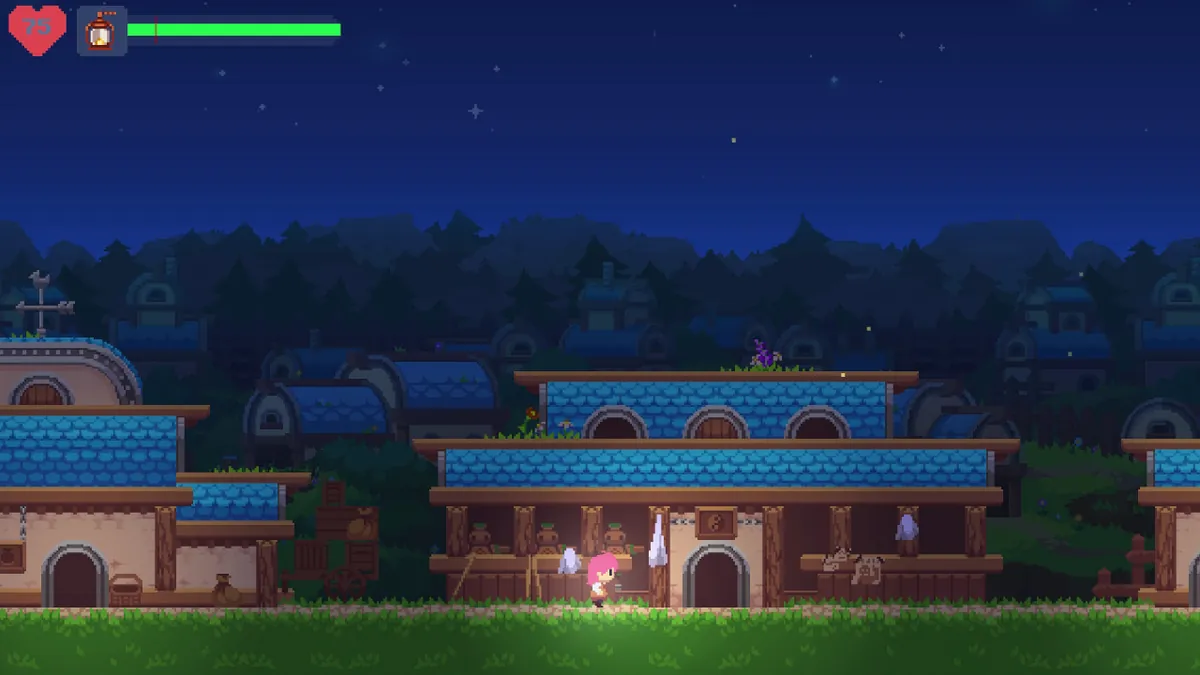
The story begins with our pink-haired protagonist Gail waking up in her room at the local orphanage. She is asked by the orphanage’s director to gather the children because it’s time for supper. These children, apparently, are allowed to play in a nearby forest, so Gail must perform a bit of tutorial infused exploration to find them all. When she finds the other oldest orphan it would seem that they were investigating a shooting star, and by joining in on that investigation you’re treated to the game’s first dungeon without too much plot getting in the way. While Gail and the other children are doing everything but hastily returning home for supper, a flying saucer suddenly appears and kidnaps everyone in the village, leaving only the absent children remaining. For the sake of survival, one orphan stays behind to organize and assist the children, while Gail is sent to the nearest city to find others to help.
Setting out with Gail feels like a true adventure partially because the situation makes it so real. Many games include youthful protagonists being thrust into unlikely situations, but rarely are all of the details for why they were “chosen” filled out so meticulously as they are in Phoenotopia Awakening. Your next quest involves a lot of talking to NPCs and looking for clues on what to do next, which ultimately leads you to dealing with a local bandit tribe. The way the game explains why anyone would trust a teenager with the most dangerous criminals in the region is satirically hilarious. Every success makes you feel awesome, and builds on the trust the game’s world gives to Gail as a character.
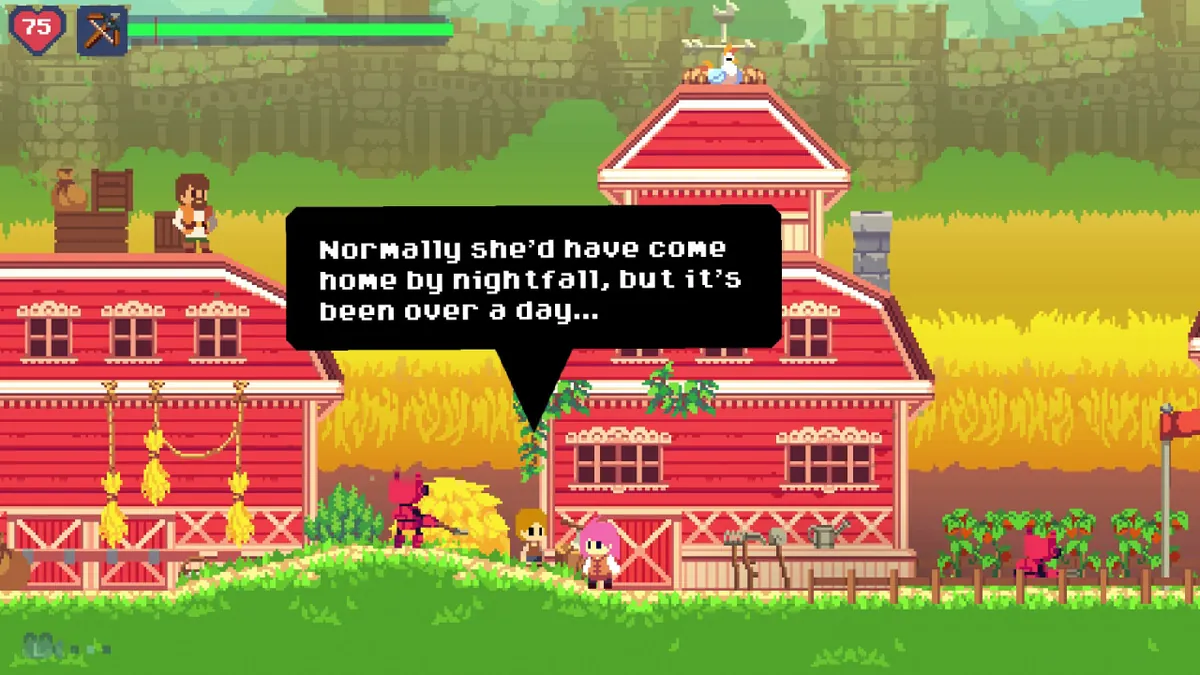
One of the reasons “realism” – or believably – is so important even with Phoenotopia’s otherwise campy atmosphere is because immersion is so important to making the game work. Between the music, the incredible amount of detail in the backgrounds, and the way the story is presented, Phoenotopia feels like a world, not just a video game. Because of this, the game is allowed to shift between intense action and slow cerebral puzzle solving without it becoming a jarring juxtaposition. “Slow burn” is a great way to describe Phoenotopia, as you’ll be spending a lot of time just chatting up NPCs and memorizing details as much as you will be getting good at the next boss’ pattern. If you can’t allow yourself to become part of its world, then you’ll likely have a very hard time with this game as the going gets tough. Thankfully Phoenotopia makes the process of immersing yourself very easy.
Past that initial first dungeon, the difficulty ramps up significantly. Much like the earlier Zelda games or the latest Breath of the Wild, doing as much as you can before the next major dungeon is going to make a world of difference in how much trouble you are going to have. There are many sidequests and optional purchases you can make that will incrementally give you more HP, stamina, or important attack options. Make the right decisions or diligently do everything possible, and you’ll still be facing a challenge. The game is built for you to use your head above all else. Part of that pre-dungeon preparation is literally preparing your inventory. Save points don’t heal you in this game, so you’ll be surviving on food items you’ve collected both inside a dungeon and what you’ve brought from outside. Poor preparation had me licking the leftover beans off of ancient cans of food looted from boxes, and I was often squeaking by with just enough HP to take another hit and nothing more. Some save points will mercifully heal you upon reloading the game, but for the most part trekking through a new area is going to be an exercise in survival.
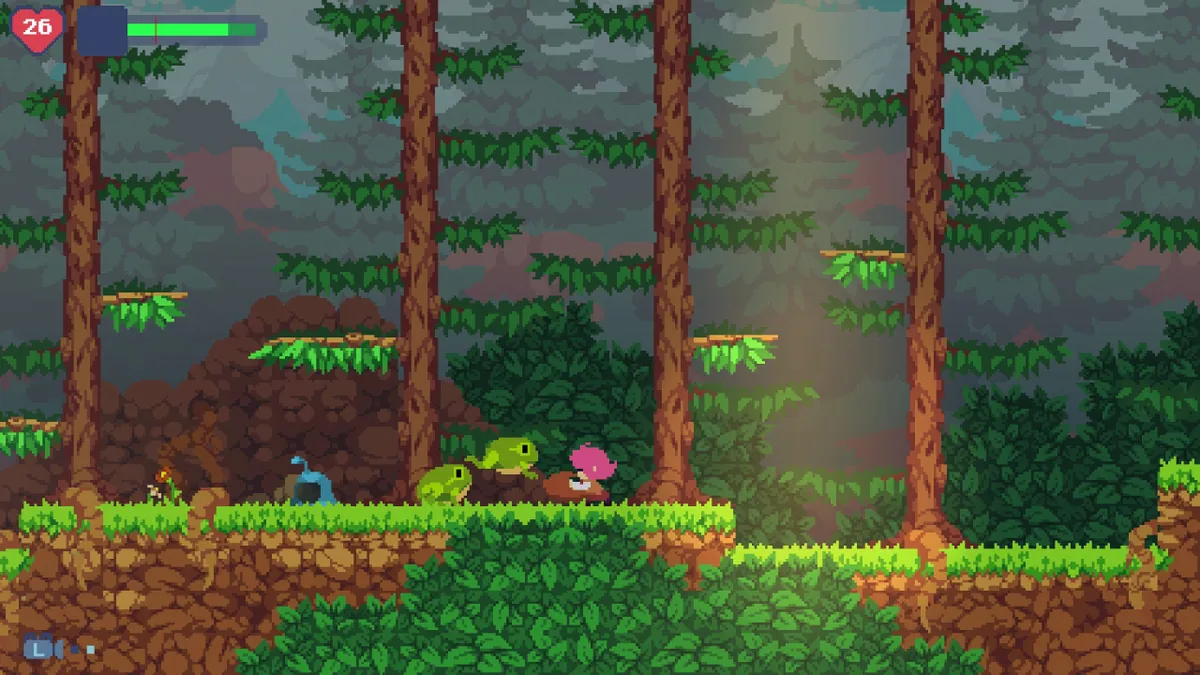
Most of the difficulty can be attributed to how combat works. Gail doesn’t start out as some all powerful being. She’s just a young girl with a baseball bat. That baseball bat has a ridiculously short range, and while there’s no automatic contact damage with enemies and you have dodge options available to you, it does require you to get in precariously close to your enemy’s next potential attack. Your aerial options are also severely limited, with the bat’s downward whack requiring too much startup time to be universally useful. Top it all off with the fact that your bat doesn’t do a ton of damage on a single hit, and you’ll quickly learn that positioning and strategy are far more important than brute force.
The strategic depth of the combat deepens with each tool you find. Weapons like the slingshot and the bomb all have “infinite ammo”, drawing from the same stamina pool that you would use to swing your baseball bat. This makes every tool an equal option from a resource standpoint, so you can use whatever weapon makes the most sense for the situation without worrying about conservation. For a lot of the early game since I was too stingy to pick up a crossbow from the shop, much of my approach involved tricking enemies into running into cooked bombs. Bosses are all designed with Gail’s toolkit in mind. Try and beat them down with only the bat, and you’ll think they’re just frustrating HP bags that take forever to kill. Observe their patterns and use your tools, and you’ll find that all of them have some kind of weakness that you can exploit, which either deals massive damage or puts them into a stunned state where you can pummel them down for a period of time with impunity.
One thing that keeps combat from having a perfect score for me is that some actions could use a little control simplification. Using the bombs as an example, you press one button to take the bomb out, and then it’s two other different buttons to either throw the bomb or set it down nicely. That initial “Take it out” button could have doubled as either a throw or a set-down; it wasn’t really necessary to spread the controls out to three buttons. Similarly, you have a dash button and a duck button, and in order to dodge roll you have to dash and then duck. This one is a little easier to justify from a design standpoint, but it took me a long time to really get the hang of doing it, which meant some of my early game experience involved a lot of trial and error.

Stumbling through dungeons will get you killed quickly, and dying in Phoenotopia Awakening has serious consequences. Many modern games have shifted towards a friendly auto-save system that generally lets you keep all your progress if you fail, usually with sending you back to the last checkpoint as the only real consequence. Not so with Phoenotopia. For this game it’s back to the oldschool “lose everything since your last save” system – which is harsher than even the earliest Zelda games. If you’ve explored several side-paths in a dungeon, solved the puzzles and gotten the rewards, and then died while proceeding further down the path, then you get to do all those puzzles over again. It is a wise choice to backtrack to the last save point any time you make any progress, unless you’re absolutely confident in the amount of food you’ve stocked up on to carry you through. More than anything else the death consequences are what define Phoenotopia’s almost brutal difficulty.
With great trials come great rewards however, and nothing replaces the delightful feeling of overcoming a genuine challenge. In spite of the aforementioned niggles I never felt like Pheonotopia was unfair, even when I was being tossed back and forth between two ghouls like a rag doll. Just based on how the game is designed there shouldn’t be any delusions that you can just run into a room and beat your foes down. You have to press forward slowly and assess every new situation. The combat itself is a puzzle, and the currency of Gail’s hp measures your success in applying your knowledge appropriately.

As tense as the combat can be it’s good that it is all broken up by more traditional puzzles. Along the critical path the primary challenge you’ll be facing will be spatial reasoning puzzles. This generally involves finding blocks or switches that you have to arrange in the proper order so that you can crawl or dash to your destination. On the side paths you’ll also find riddles and cryptographic clues. You’re given a flute which you use to activate musical locks, and hidden around the game world are many locks where the necessary song is something you have to decode. For the first time in a long time I actually had to pull out a piece of paper and pen to take notes and rearrange clues to solve some of Phoenotopia’s challenges. Most of the game’s hardest puzzles are “optional”, but because of the aforementioned difficulty you’re going to want to do as many as you can for the rewards. Besides, they’re a ton of fun, and it’s also worth mentioning that getting the player involved with playing some of the game’s music is another way Phoenotopia makes you a part of its world.
Even though the game is technically divided into four basic areas, there is an enormous number things to do, and there’s so much variety that it almost never gets old. There’s ancient artifact hunting, NPC relationship sidequests, trading sequences, dungeon clubs, fishing and cooking, collecting moonstones, hearts, and stamina gems, and so many other little things that the only way to categorize them is to list them individually. For a few dungeons, especially the final one, I had to simply walk away for a while because of how hard it can get, but I would almost immediately find myself distracted by a chain of completely optional events that created an addictive circuit of discovery and rewards. Exploration in Phoenotopia Awakening doesn’t always just give you more HP or Energy, but sometimes unique new tools, or it may even uncover entire dungeons you might have otherwise missed. In short, the exploration is full of surprises.
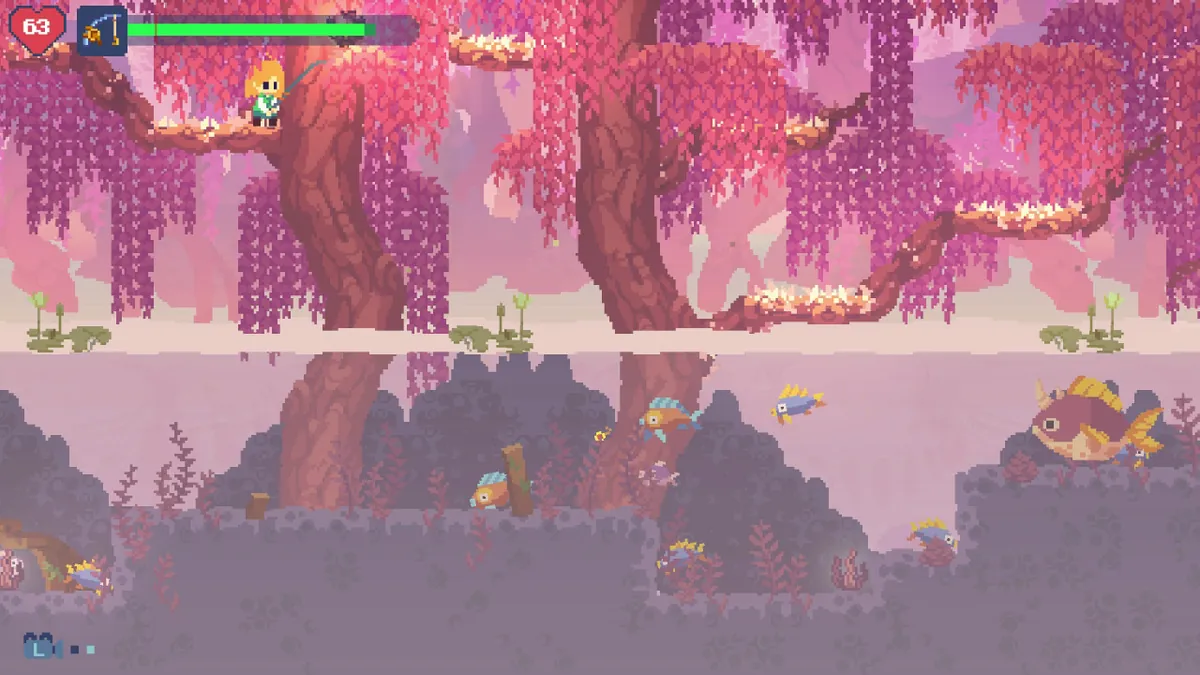
The combat, the puzzles, and the exploration all combine to make Phoenotopia Awakening a deep and engaging experience. I think some players may be put off by the challenge and dire consequences for failure, but I also think that Phoenotopia does an excellent job building up enough goodwill and promising great things to come to make it worth pushing through it. The highly challenging parts are also broken up by a greater number of slower and more relaxing parts where you’re just solving a puzzle or doing some plain ol’ fishing at the beach. I personally put more than 35 hours into the game and not once did I feel like it was getting repetitive or boring. The story it tells is also almost worth it all by itself, and this game creates a universe that could easily be expanded on with sequels, which is something I definitely look forward to. Phoenotopia Awakening deserves to be included among the best games, and while some players may want to wait until some accessibility options are patched in to mitigate its difficulty, it’s definitely a game you don’t want to ignore.
Difficulty
How hard is Phoenotopia Awakening?
Yes. Phoenotopia Awakening scores 80/100 on our difficulty scale, the #31 hardest of 207 Metroidvanias reviewed here. Built to punish — expect to die a lot and learn patterns the hard way.
- Our review: rated high difficulty.
- Steam players: 48% of 211 English reviews describe it as hard, 17% as easy — harder-rated than 86% of games here.
Final verdict
Phoenotopia Awakening
While the difficulty and some features may grate against individual preferences, its immersiveness and gameplay variety combine to make Phoenotopia Awakening an absolute masterpiece.
Metroidvania breakdown
Combat
4/5The button scheme is a little over complex, and perhaps being hit is a little too punishing, but ultimately the combat is strategic and rewarding when you get good at it.
Platforming
3.5/5There are definitely times that Phoenotopia tests your platforming dexterity, but it's not a constant focus with the exception of puzzle platforming
Exploration
5/5There is so much stuff in Phoenotopia to discover, and all of it gives you incremental benefits when they're not wildly game changing. It can keep you busy for well over 40-50 hours.
Puzzle
5/5There's a ton of variety ranging from deciphering clues for music puzzles to figuring out the correct pathway to proceed forward or into secret areas
Story
4.5/5Meticulously well-crafted lore creates a believable universe while also enabling laugh out loud humor, charming moments, and valuable lessons.
Graphics
5/5Soft colors and incredible detail on the backgrounds make for a relaxing visual world to immerse yourself in
Music
5/5Not only is the music basically perfect for the mood the game sets, but it also plays into the gameplay, with melodies that will be stuck in your head for days.
Replayability
4/5While it's not likely you'll want to 100% complete the game every time you play, you do have many choices that could diversify any new playthrough. Puzzles of course lose some value once you've solved them once, so some space between playthroughs may be recommended.
The Nintendo Switch review code used to play Phoenotopia Awakening was provided by Cape Cosmic.
Featured in
Further reading
If you liked Phoenotopia Awakening
All reviews →
Aggelos
An expertly crafted callback to simpler times while still maintaining a modern approach to game design. Unique and imaginative power-ups and puzzles place Aggelos above the competition. Share

Cathedral
Satisfying bosses, nostalgic presentation, and most of all incredible level design make Cathedral a hidden gem for anyone that might enjoy its Zelda-like brand of Metroidvania exploration.

Alwa’s Legacy
A magic based puzzle platformer with unique Zelda-like dungeons and a large overworld full of optional secrets. Excellent level design and clever gimmicks makes exploration a delight.